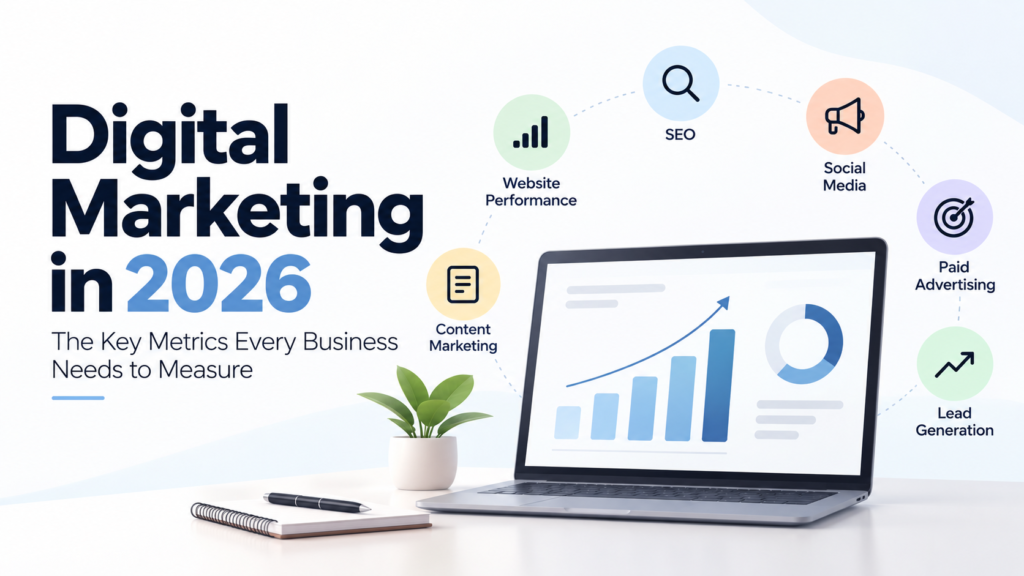
Ultimate Digital Marketing Metrics for 2026 You Must Track The digital marketing 2026 landscape is evolving rapidly. Businesses are no longer competing only for website traffic, social media followers, or online visibility. They are focusing on meaningful engagement, qualified leads, customer retention, and measurable business growth. With the rise of artificial intelligence and AI-powered search engines, understanding the right marketing metrics has become essential. Personalized marketing and data-driven advertising further increase this need. Simply investing in digital marketing 2026 is not enough. Businesses must measure performance, understand customer behavior, and identify which strategies deliver real results. At Siara Media Solutions, we believe success begins with the right strategy. It continues through consistent performance tracking and optimization for digital marketing 2026. 1. Website Traffic and User Engagement Your website is often the first point of contact between your business and potential customers. Measuring website traffic helps you understand how people discover your brand and which marketing channels bring visitors to your website. In 2026, businesses should look beyond the total number of visitors and focus on the quality of website traffic. Organic traffic, referral traffic, direct visits, and visitors from social media or paid advertising can reveal which channels are attracting the right audience. User engagement is equally important. Metrics such as engagement rate, returning visitors, landing page performance, and the number of meaningful interactions help businesses understand whether their website content meets customer expectations. A website that attracts fewer visitors but generates more inquiries can be more valuable than one with high traffic and no conversions. By analyzing website performance regularly, businesses can improve their content, enhance user experience, and turn more visitors into potential customers. 2. Search Engine Optimization (SEE) Performance Search Engine Optimization continues to play a major role in digital marketing in 2026. Customers frequently use search engines to discover products, compare services, and find solutions to their problems. A strong SEE strategy helps businesses appear when potential customers are actively searching for relevant information. To measure SEE performance effectively, businesses should monitor keyword rankings, organic search clicks, search impressions, click-through rates, back-links, and technical website health. However, rankings alone do not determine success. The real value of SEE lies in attracting relevant visitors who engage with the website and take meaningful actions. Another important development is the growth of AI-powered search experiences. Businesses should pay attention to how their content appears in AI-generated answers, whether their websites are cited as sources, and whether AI-referred visitors generate inquiries or conversions. Creating helpful, original, and trustworthy content is essential for improving visibility across traditional search and emerging AI-driven discovery platforms. At Siara Media Solutions, we recognize that effective SEE is not just about ranking higher on Google; it is about connecting businesses with the right audience at the right time. 3. Social Media Marketing Metrics Social media has become an essential channel for building brand awareness, communicating with customers, and generating business opportunities. However, measuring social media success through likes and follower counts alone can provide an incomplete picture. In 2026, businesses should focus on reach, impressions, engagement rate, shares, saves, video watch time, profile visits, and website clicks. These metrics help identify which content formats capture attention and encourage audiences to interact with a brand. More importantly, businesses should measure how social media contributes to actual business outcomes. Inquiries through direct messages, website visits, qualified leads, and sales can provide a clearer understanding of campaign effectiveness. For example, a short video with fewer views may generate more qualified inquiries than a highly viewed post that receives little meaningful engagement. This is why understanding audience intent is just as important as creating attractive content. A successful social media strategy combines creative storytelling, consistent communication, audience research, and performance analysis to build a strong and recognizable online presence. 4. Paid Advertising and Campaign Performance Paid advertising through platforms such as Google Ads and Meta Ads can help businesses reach targeted audiences, generate leads, and increase sales. However, effective advertising requires more than setting a budget and launching a campaign. Businesses should regularly monitor cost per click, click-through rate, conversion rate, cost per lead, and cost per acquisition. These metrics help marketers understand how efficiently advertising budgets are being used and whether campaigns are reaching the intended audience. Return on ad spend, commonly known as ROAS, is another important metric. It measures the revenue attributed to advertising relative to the amount spent on ads. For example, if a business spends ₹10,000 on an advertising campaign and generates ₹40,000 in attributed revenue, the campaign has a ROAS of 4×. However, a high ROAS does not automatically guarantee profitability. Businesses must also consider product costs, operational expenses, service delivery costs, and other marketing expenses when evaluating overall performance. In 2026, the goal of paid advertising should be to attract the right customers, improve conversion efficiency, and generate sustainable returns rather than simply maximizing clicks or impressions. 5. Lead Generation and Conversion Rates Lead generation is one of the most important objectives for businesses investing in digital marketing. Whether a company offers professional services, educational programs, real estate solutions, or online products, the ability to attract and convert potential customers directly influences growth. Businesses should measure the number of leads generated, the percentage of qualified leads, landing page conversion rates, cost per lead, and the percentage of leads that eventually become paying customers. Conversion rate is particularly valuable because it shows how effectively a website or campaign encourages people to take action. These actions may include filling out a contact form, requesting a quotation, booking a consultation, signing up for a newsletter, or completing a purchase. Improving conversion rates often involves making landing pages clearer, strengthening calls to action, simplifying inquiry forms, improving website speed, and providing relevant information that addresses customer concerns. By tracking the entire journey from the first website visit to the final purchase, businesses can identify where potential customers lose interest and make improvements that increase marketing effectiveness. 6. Digital Marketing ROI Return on investment, or ROI, is